
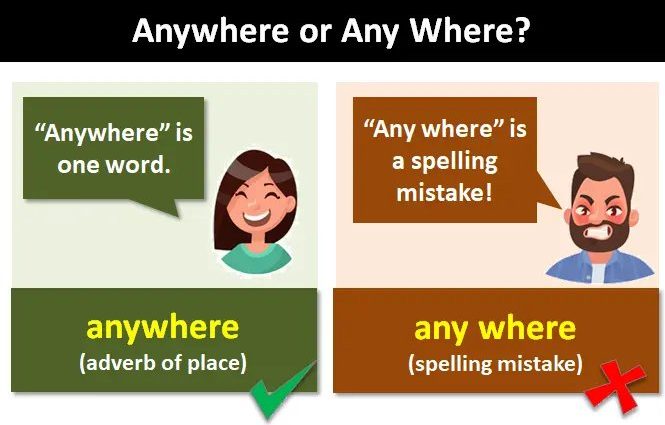
Anywhere vs any where? The correct usage depends on the context. “Anywhere” is an adverb that means any place, while “any where” is simply incorrect. Remember, the distinction lies in the lack of space between “any” and “where.” Let’s delve into this common language dilemma and uncover the nuances that separate these two seemingly similar terms. Whether you’re communicating through writing or speaking, understanding the subtle differences can elevate your language skills. Let’s demystify anywhere vs any where together.

Anywhere vs Any Where: Understanding the Difference
Welcome to our guide on the difference between ‘anywhere’ and ‘any where.’ These two terms may look similar, but they have distinct meanings in the English language. In this article, we will delve deeper into the nuances of each word and how they are used in sentences. So, let’s jump right in and explore the wonderful world of words!
What is ‘Anywhere’?
Let’s start with ‘anywhere.’ This term is commonly used to refer to a place that is unspecified or not limited to a specific location. When you say you can go ‘anywhere,’ it means you have the freedom to choose any place without restrictions. ‘Anywhere’ is an adverb that indicates a non-specific location or direction.
For example, if you tell your friend, “I’m willing to travel anywhere for a good adventure,” you are expressing your readiness to explore various places without specifying a particular destination.
Understanding ‘Any Where’
On the other hand, ‘any where’ consists of two separate words: ‘any’ and ‘where.’ In this context, ‘any’ is used as a determiner to convey an indefinite quantity or choice, while ‘where’ serves as an adverb or a conjunction to denote a location or position.
When ‘any’ and ‘where’ are used together, they emphasize the idea of choosing from multiple locations without restrictions. However, unlike ‘anywhere,’ ‘any where’ is not a standard phrase in modern English. It is considered outdated and redundant in most cases.
For instance, saying, “You can pick a book from any where in the library,” is technically correct but sounds awkward compared to using ‘anywhere’: “You can pick a book from anywhere in the library.”
Examples of ‘Anywhere’ in Sentences
Here are a few examples to help you understand how ‘anywhere’ is used in sentences:
1. I can work from anywhere as long as I have my laptop and an internet connection.
2. Are you going anywhere special for your birthday?
3. The package can be delivered anywhere in the world within a week.
Common Mistakes with ‘Anywhere’ and ‘Any Where’
It’s easy to confuse ‘anywhere’ and ‘any where’ due to their similar spelling and pronunciation. Here are some common mistakes people make when using these terms:
1. Writing ‘Any Where’ as Two Separate Words
As mentioned earlier, ‘any where’ as two separate words is not the standard or preferred way to express the idea of an unrestricted location. To avoid confusion and maintain clarity in your writing, it’s best to use ‘anywhere’ as a single word when referring to a non-specific place.
2. Overusing ‘Anywhere’ in Place of ‘Somewhere’
While ‘anywhere’ suggests an open-ended choice of location, it’s essential to differentiate it from ‘somewhere,’ which implies a specific but unspecified place. Make sure to use ‘anywhere’ when you mean any place without constraints and ‘somewhere’ when referring to a particular but unspecified spot.
When to Use ‘Anywhere’ and ‘Somewhere’
Now that we’ve clarified the difference between ‘anywhere’ and ‘any where,’ let’s explore the situations where each term is most appropriate:
Using ‘Anywhere’
‘Anywhere’ is ideal for expressing a lack of limitation or restriction regarding a location. You can use ‘anywhere’ in the following scenarios:
- Indicating a willingness to go to any place: “I’m happy to meet you anywhere you prefer.”
- Referring to the flexibility of travel or choice: “You can find affordable accommodations anywhere in the city.”
- Stating the possibility of an action across various locations: “You can buy this product anywhere online.”
Using ‘Somewhere’
‘Somewhere’ is more appropriate when you want to suggest a specific but unspecified location. Consider using ‘somewhere’ in the following contexts:
- Hinting at a particular but unspecified place: “I left the keys somewhere around the house.”
- Implying the existence of a suitable option without specifying it: “Let’s go somewhere quiet for our meeting.”
- Expressing uncertainty about a specific location: “There must be a solution somewhere in this document.”
As we wrap up our exploration of ‘anywhere’ and ‘any where,’ remember that clear communication is key to effective writing and speaking. While ‘anywhere’ is the preferred term for indicating a non-specific location, ‘somewhere’ serves the purpose of hinting at a particular but unspecified place.
By understanding the nuances of these terms and using them appropriately in your everyday language, you can enhance your communication skills and avoid common grammatical errors. So, the next time you plan to go ‘anywhere’ or leave something ‘somewhere,’ choose your words wisely to convey your message accurately.
Thank you for joining us on this linguistic journey. Stay tuned for more language tips and tricks in our upcoming articles!
SOME vs ANY someone anyone | something anything | somewhere anywhere ENGLISH GRAMMAR with EXAMPLES
Frequently Asked Questions
What is the difference between “anywhere” and “any where”?
“Anywhere” is a single word that refers to any place or location without restriction. On the other hand, “any where” would typically be used when emphasizing the idea of selecting a specific place out of many options.
Can “anywhere” and “any where” be used interchangeably?
While they are similar, “anywhere” is more commonly used in everyday language to indicate a general location, whereas “any where” is used less frequently and typically to emphasize a specific choice or selection among various options.
When should I use “anywhere” in a sentence?
Use “anywhere” when you want to convey the idea of any place without limitation or specification. For example, “I can meet you anywhere in the city.”
How can I use “any where” effectively in my writing?
Consider using “any where” when you want to emphasize a particular location among multiple choices. For instance, “You can park your car any where in the parking lot.”
Final Thoughts
When deciding between ‘anywhere’ and ‘any where’, it’s essential to understand the distinction. ‘Anywhere’ is used to refer to a non-specific place, while ‘any where’ indicates the possibility of selecting a particular location. The key is to remember that ‘anywhere’ is a single word denoting a broad location, while ‘any where’ separates the two words to emphasize choice. Choose wisely based on your intended meaning to ensure clear and effective communication, avoiding confusion over ‘anywhere vs any where’.